

HER: Human-like Reasoning and Reinforcement Learning for LLM Role-playing
Paper • 2601.21459 • Published • 10





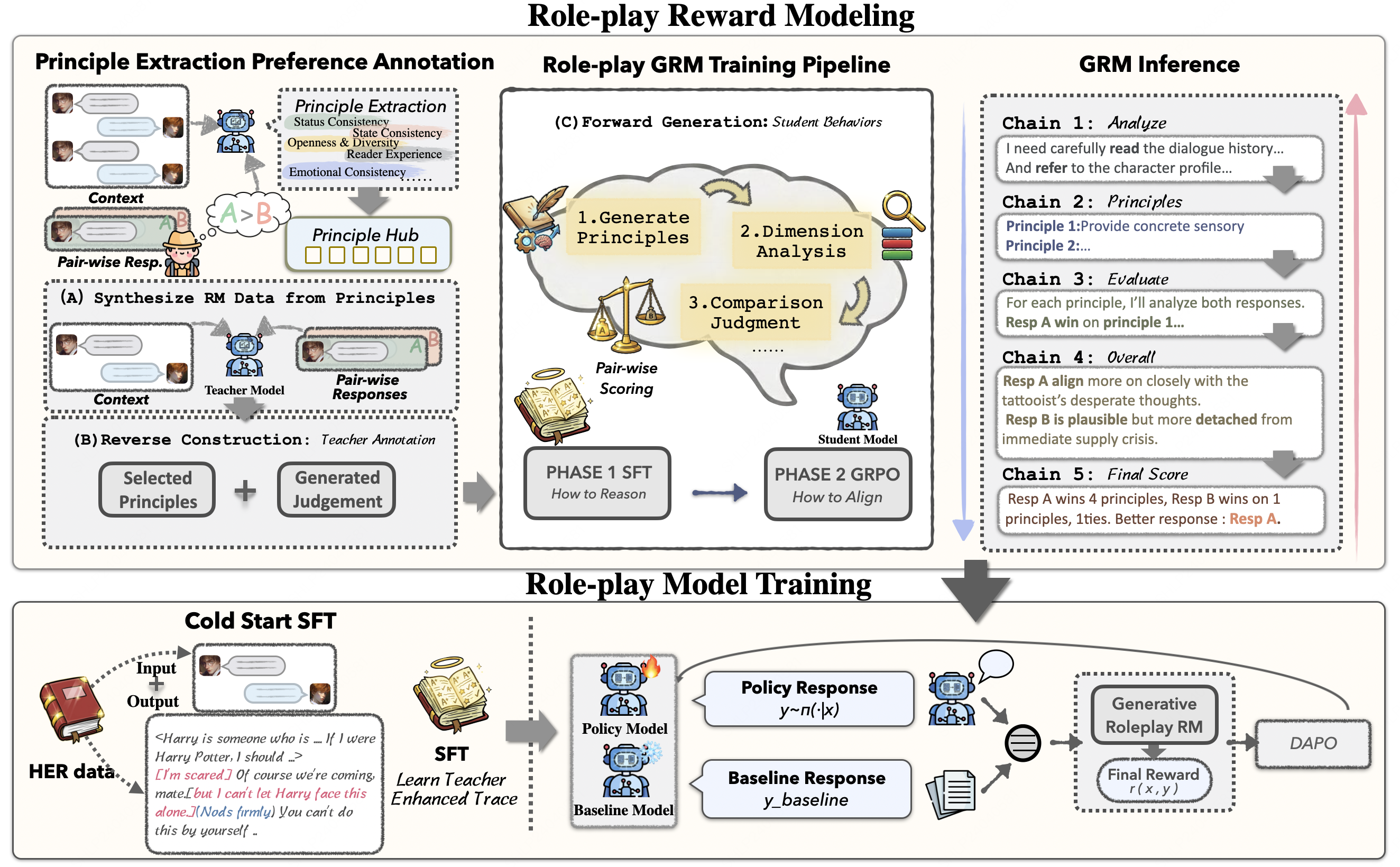
HER introduces dual-layer thinking that distinguishes characters' first-person thinking from LLMs' third-person thinking for cognitive-level persona simulation.
HER-RM is a Generative Reward Model (GenRM) specifically designed for evaluating role-playing responses. Unlike traditional reward models that output a single scalar score, HER-RM generates by-case evaluation principles based on the dialogue context and provides detailed comparative analysis.
HER-RM identifies implicit human preferences from the dialogue context and generates by-case principles to guide its own scoring. This approach enables more nuanced evaluation compared to fixed rubrics.
The model expects a structured prompt with:
##prompt info
### Role
You are the world's best data annotator, specializing in distinguishing differences between different responses in the same role-playing scenario.

### Background
You will receive content information including **character background settings**, **dialogue context**, **dialogue continuation**, **response candidate 1**, and **response candidate 2**. You must generate relevant evaluation principles based on the dialogue context and compare the two candidate responses.

The format of **dialogue history** is as follows, where "(system)" after the character name represents system output, "(assistant)" represents model output, and "(user)" represents user output:

id:1, npc_name1(system): (background settings...)
id:2, npc_name2(assistant): (dialogue content...)
id:3, npc_name3(user): (dialogue content...)

### Key Concepts: Dimensions vs Principles

The evaluation schema contains two hierarchical levels:
- **Dimensions**: broad categories used to organize principles (structural labels only)
- **Principles**: concrete judgment rules under each dimension (actual units for comparison)

Each principle includes:
- **definition**: the rule you must apply
- **level**: "sentence" (judged from current utterance) or "session" (requires full dialogue history)

You must:
- Generate principles relevant to the current dialogue context
- Always evaluate negative principles (if applicable)
- Use positive principles only when they meaningfully distinguish the two responses
- Generate 3-5 principles that best capture the differences
- For each generated principle, compare cand_1 and cand_2 and decide the winner

### Evaluation Process

1. Carefully read the entire dialogue history, sentence by sentence
2. Evaluate all negative principles first (violations → immediate winner/tie)
3. Generate relevant positive principles only for meaningful differences
4. For each principle: analyze both candidates, provide evidence, decide winner
5. Consider: number of wins, principle importance, degree of difference
6. Make final decision: "cand_1", "cand_2", or "tie"

### Output Format

Return JSON format:

{
  "result": [
    {
      "cand_1": "Response candidate 1 original text",
      "cand_2": "Response candidate 2 original text",
      "principle": {
        "Principle 1": {
          "principle_name": "Name of the principle",
          "dimension_name": "Dimension category",
          "principle_level": "sentence or session",
          "main_content": "Principle description",
          "reason_for_choosing": "Why this principle matters for this context"
        }
      },
      "analysis": {
        "principle_comparisons": [
          {
            "principle_name": "Principle name",
            "principle_level": "sentence or session",
            "cand_1_performance": "Analysis of Response 1",
            "cand_2_performance": "Analysis of Response 2",
            "comparison_reason": "Detailed comparison with degree of difference",
            "winner": "cand_1 or cand_2 or tie"
          }
        ],
        "overall_analysis": "Overall analysis of all principles",
        "principle_summary": "Statistics of wins/losses with weights and degrees"
      },
      "better_response": "cand_1 or cand_2 or tie"
    }
  ]
}

### Input

**Dialogue Context**
{context}

**Response Candidate 1**
{cand_1}

**Response Candidate 2**
{cand_2}
from transformers import AutoModelForCausalLM, AutoTokenizer
import json
import re

model_name = "ChengyuDu0123/HER-RM-32B"
tokenizer = AutoTokenizer.from_pretrained(model_name)
model = AutoModelForCausalLM.from_pretrained(
    model_name,
    torch_dtype="auto",
    device_map="auto"
)

# Prepare input
context = """System: You are Elizabeth Bennet from Pride and Prejudice.
A witty, intelligent young woman who values honesty and integrity.

User: Mr. Darcy approaches you at the ball. What do you say?"""

cand_1 = """<role_thinking>He looks so proud, standing there as if he owns the room.</role_thinking>
<role_action>raises an eyebrow slightly</role_action>
Mr. Darcy. I did not expect to see you here tonight."""

cand_2 = """Hello Mr. Darcy! How are you doing? Nice weather we're having!"""

# Build prompt (simplified version, see full template above)
prompt = f"""##prompt info
### Role
You are the world's best data annotator, specializing in distinguishing differences between different responses in the same role-playing scenario.

### Input

**Dialogue Context**
{context}

**Response Candidate 1**
{cand_1}

**Response Candidate 2**
{cand_2}

Please generate evaluation principles and compare the two responses."""

messages = [{"role": "user", "content": prompt}]
text = tokenizer.apply_chat_template(messages, tokenize=False, add_generation_prompt=True)
inputs = tokenizer([text], return_tensors="pt").to(model.device)

# Generate
outputs = model.generate(
    **inputs,
    max_new_tokens=2048,
    temperature=0.7,
    top_p=0.9
)
response = tokenizer.decode(outputs[0][len(inputs.input_ids[0]):], skip_special_tokens=True)

# Parse result
match = re.search(r'"better_response":\s*"(\w+)"', response)
if match:
    print(f"Winner: {match.group(1)}")
HER-RM evaluates responses across 12 dimensions, organized into:
The reward model was trained on:
@article{her2025,
  title={HER: Human-like Reasoning and Reinforcement Learning for LLM Role-playing},
  author={Chengyu Du, Xintao Wang, Aili Chen, Weiyuan Li, Rui Xu, Junteng Liu, Zishan Huang, Rong Tian, Zijun Sun, Yuhao Li, Liheng Feng, Deming Ding, Pengyu Zhao, Yanghua Xiao},
  journal={arXiv preprint arXiv:2601.21459},
  year={2026}
}
This project is licensed under the Apache 2.0 License.
Paper | HER-RL Model | Dataset | GitHub
Made with ❤️ for better AI role-playing